The most fundamental problem in computer science is problem decomposition: how to take a complex problem and divide it up into pieces that can be solved independently.
It’s all about complexity.
Complexity
Complexity is anything related to the structure of a software system that makes it hard to understand and modify the system.
Complexity manifests itself in three general ways:
Change amplification: a seemingly simple change requires code modifications in many different places.
Cognitive load: A higher cognitive load means that developers have to spend more time learning the required information.
Unknown unknowns: It is not obvious which pieces of code must be modified to complete a task, or what information a developer must have to carry out the task successfully. This is the worst kind of complexity.
Complexity is caused by two things:
- dependencies:
- obscurity
So there are two general approaches to fighting complexity:
clean code: Eliminating complexity by making code simpler and more obvious.
modular design: A software system is divided up into modules, such as classes in an object-oriented language. The modules are designed to be relatively independent of each other, so that a programmer can work on one module without having to understand the details of other modules
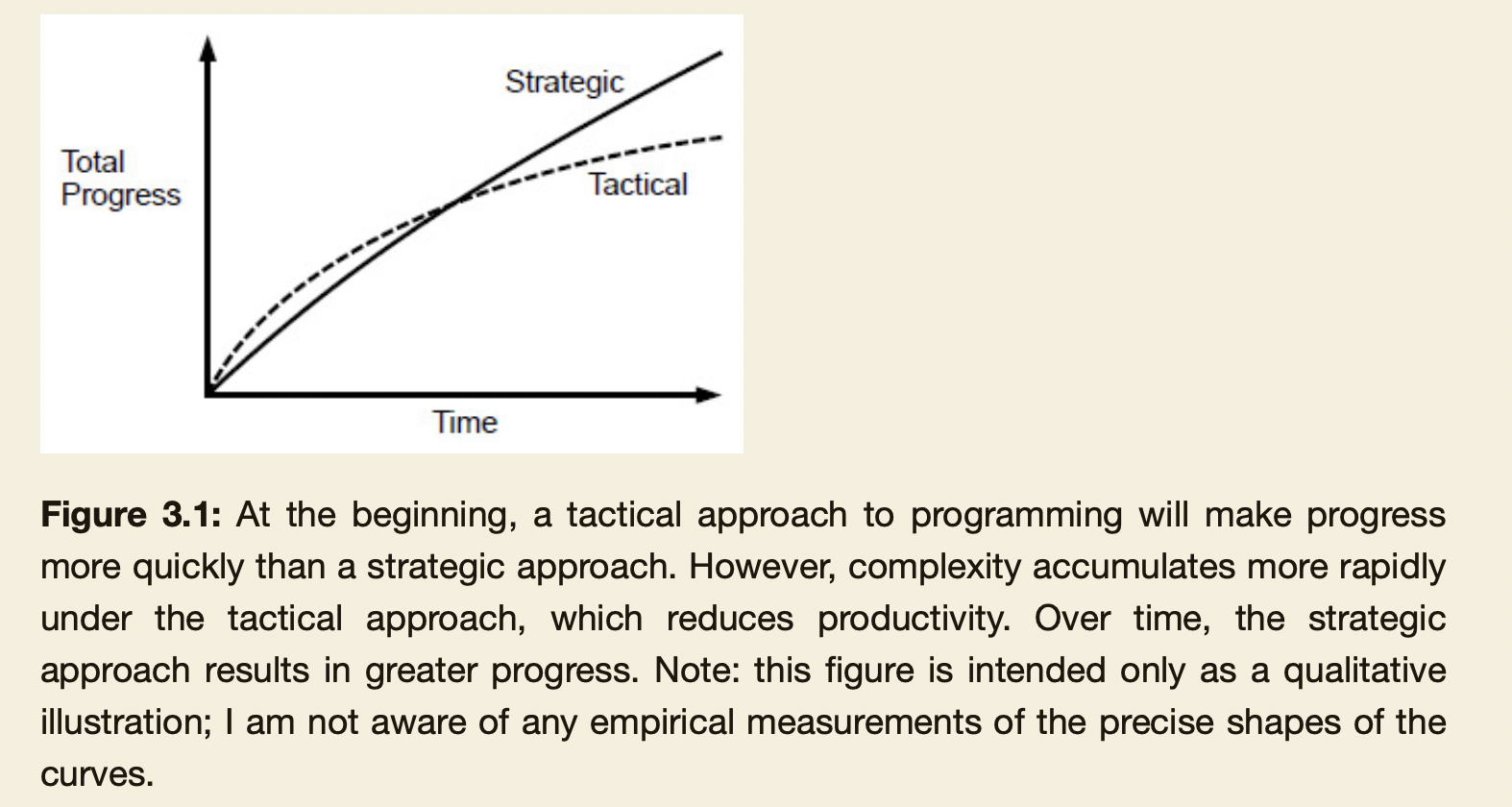
Strategic vs. Tactical Programming
Tactical programming means that your main focus is to get something working as soon as possible, such as a new feature or a bug fix, but it is short-sighted. It will make the system more complex in the future.
The first step towards becoming a good software designer is to realize that working code isn’t enough. Your primary goal must be to produce a great design, which also happens to work.
Modular Design
Different Layer, Different abstraction
Software systems are composed in layers, where higher layers use the facilities provided by lower layers. In a well-designed system, each layer provides a different abstraction from the layers above and below it; if you follow a single operation as it moves up and down through layers by invoking methods, the abstractions change with each method call.
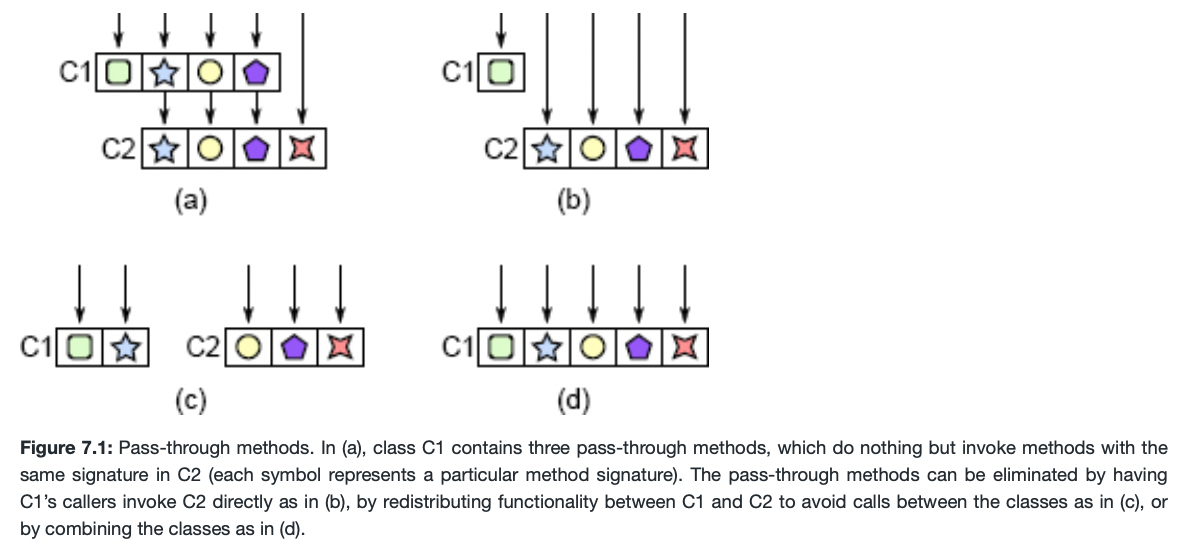
Pass-through methods If different layers have the same abstraction, such as pass-through methods or decorators, then there’s a good chance that they haven’t provided enough benefit to compensate for the additional infrastructure they represent.
There are several solutions for remove pass-through methods.
- Expose the lower level class directly to the callers of the high level class.
- Redistribute the functionality between the classes.
- Merge theme
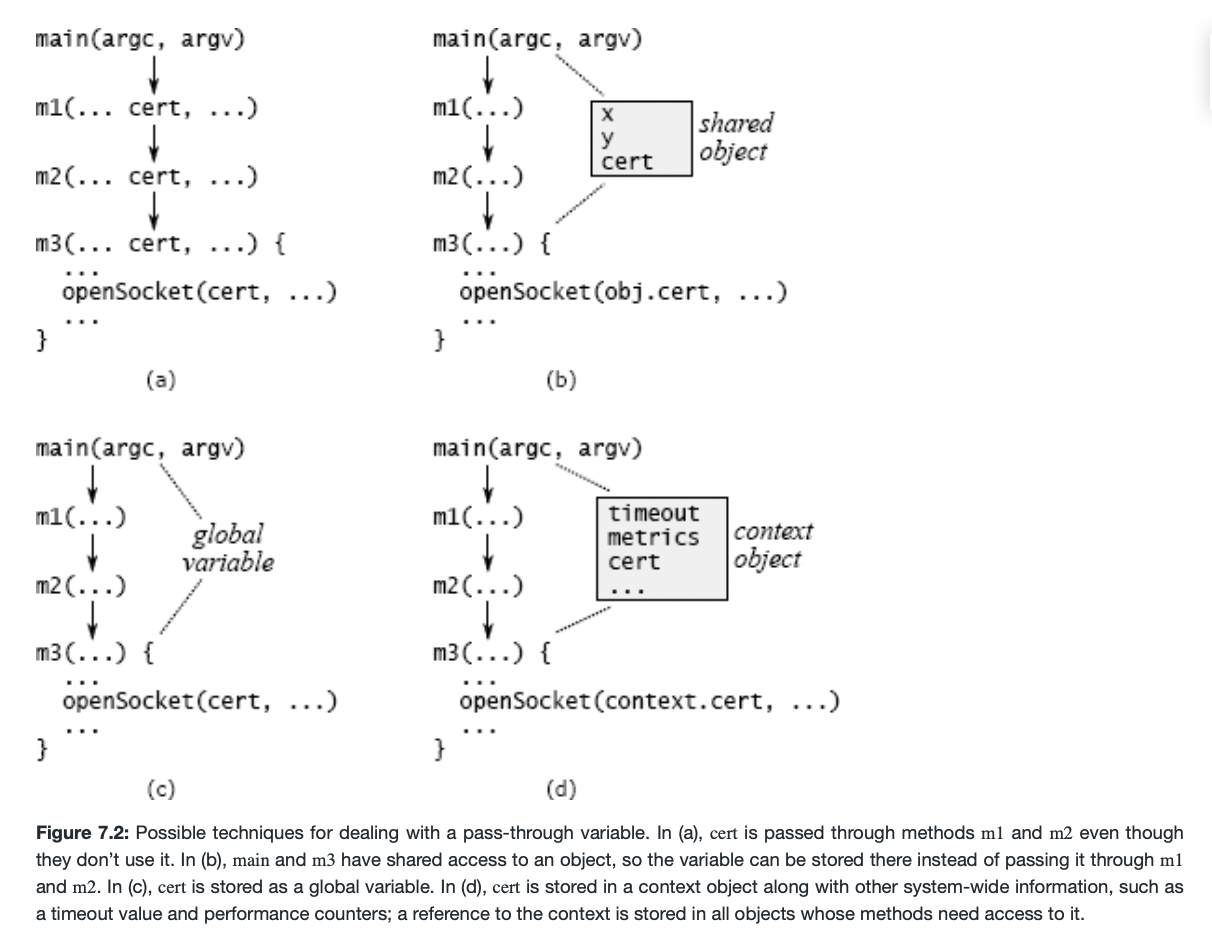
Pass-through variable Another form of API duplication across layers is a pass-through variable, which is a variable that is passed down through a long chain of methods.
Pass-through variables add complexity, if a new variable comes into existence, you may have to modify a large number of interfaces and methods to pass the variable through all of the relevant paths.
You can use these methods for eliminating pass-though variables:
- Shared object
- Global variables
- Context object, this is better
Decorators
The decorator design pattern (also known as a “wrapper”) is one that encourages API duplication across layers. However, decorator classes tend to be shallow: they introduce a large amount of boilerplate for a small amount of new functionality.
You can consider alternatives before creating a decorator class:
- Add new functionality directly to the underlying class.
- If the new functionality is specialized for a particular use case, would it make sense to merge it with the use case, rather than creating a separate class?
- Merge the new functionality with an existing decorator.
- Could you implement it as a stand-alone class that is independent of the base class?
Design general-purpose modules
Most modules have more users than developers, so it is better for the developers to suffer than the users. So it is more important for a module to have a simple interface than a simple implementation.
Pulling complexity down when:
- the complexity being pulled down is closely related to the class’s existing functionality.
- pulling the complexity down will result in simplifications elsewhere in the application
- pulling the complexity down simplifies the class’s interface.